Kalpana Chawla 2025| Incredible Astronaut, Biography, Net Worth, Space Missions
Dreams Know No Boundaries
Introduction
Kalpana Chawla was an Indian origin American astronaut and aerospace engineer who became the first woman of Indian descent to go to space. Her first flight as a mission specialist and primary robotic arm operator was on STS-87 aboard Space Shuttle Columbia in 1997. Her second flight on STS-107 was the final flight of Columbia in 2003 when she met her tragic end along with six crew members while re-entering into the earth’s orbit. She spent more than 30 days in space over two space shuttle missions.
She was the second Indian person to fly in space, following cosmonaut Rakesh Sharma who flew in 1984 in a spacecraft. She was deeply passionate about space exploration and believed in the power of science and technology to improve the world.
Chawla’s legacy has lived on. Her life and career are a testament to the power of perseverance, dedication, and pursuit of excellence, inspiring young people in India and around the world to consider careers in spaceflight.
Kalpana Chawla and her Early Life
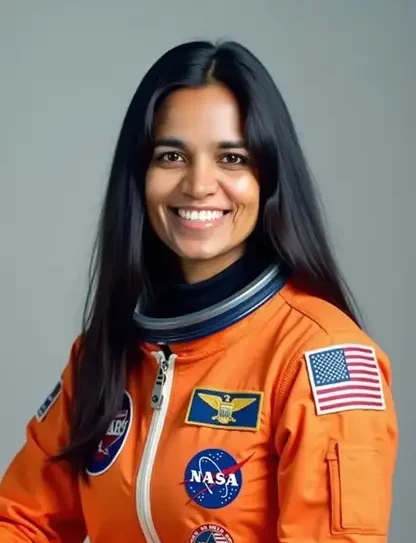
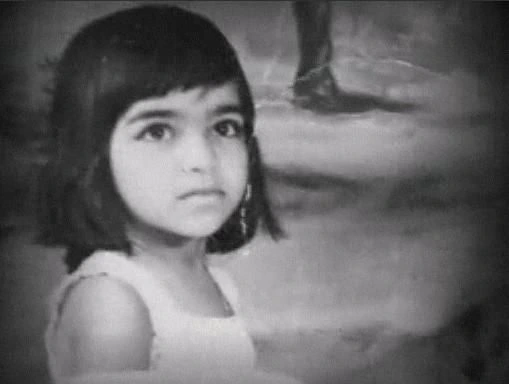
- On 17 March 1962, Kalpana Chawla was born to parents, Banarasi Lal Chawla and Sanjyothi Chawla in Karnal, a small town in the northern state of Haryana, India.
- Her father was an entreprenuer and mother was a social worker.
- She was the youngest of four siblings in a middle-class family but she surpassed all barriers to become the first Indian-born female astronaut.
- She was named Montu by her parents till she attended school. Chawla picked her own name Kalpana which means “idea” or “imagination.” People often called her by the nickname K.C.
Kalpana Chawla and her Education
- As a child, she was fascinated by flights and would enjoy visiting local flying club with her father and watching planes take off and land. This ignited an interest in aviation despite being brought up in a small town.
- She went to Tagore Baal Niketan Senior Secondary School, Karnal, Haryana for her primary and secondary schooling in India.
- She was an industrious student and performed well in her academics, especially in science and mathematics.
- Kalpana’s strong sense of curiosity and a passion for learning helped her to pursue her dream.
- She earned a Bachelor degree in aeronautical engineering at Punjab Engineering College (PEC), Chandigarh in 1982.
- She was the only girl in her batch to study aeronautical engineering, a testament to her pioneering spirit and determination to achieve something that she always aspired for.
- Even Professors tried to discourage her from choosing the degree as there were few options for females in India. However, Chawla’s unwavering love and commitment towards science drove her to follow her passion.
Kalpana Chawla and her Higher Education
- In 1982, she moved to the United States and enrolled at the University of Texas at Arlington (UTA). She obtained a Master of Science degree in Aerospace Engineering in 1984.
- She earned high praise from her professors and peers for her academic excellence and research capabilities.
- Then she went to earn a second Master’s in 1986.
- She did a Doctorate of philosophy (Ph.D.) in aerospace engineering from the University of Colorado Boulder in 1988.
- Her research focused on computational fluid dynamics, a field that involves the study of fluid flow and its applications in aerospace engineering.
- Her work was highly appreciated, and she made significant contributions to the field.
Kalpana Chawla and her Career as an Astronaut
Kalpana Chawla and Nasa’s Ames Research Center (1988)
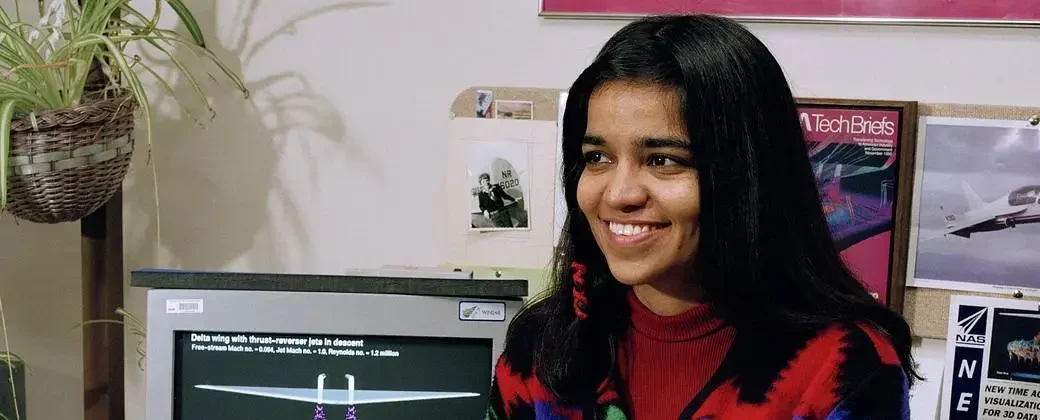
- Her career started at NASA’s Ames Research Center, specialized in computational fluid dynamics for motorized lifts in 1988.
- She worked on various projects related to the development of advanced aircraft and spacecraft systems.
- She conducted research on extensive use of computational simulations and wind tunnel testing to study the behavior of aircraft and spacecraft in different flight conditions.
Kalpana Chawla and Overset Methods Inc., California (1993)
- Kalpana Chawla joined Overset Methods Inc., Los Altos, California, as Vice President and Research Scientist in 1993.
- She formed a team with other researchers specializing in the simulation of moving multiple body problems.
- She developed efficient methods to perform aerodynamic optimisation.
- The findings of her project works are documented in technical conference papers and journals.
Kalpana Chawla and an Astronaut Candidate (1994)
- NASA chose her in December 1994, and she began working for the agency in January 1995.
- She was selected as an astronaut candidate in the 15th Group of Astronauts at the Johnson Space Center in Mar 1995.
- Besides being trained for spaceflight, she worked on ground –based technical projects.
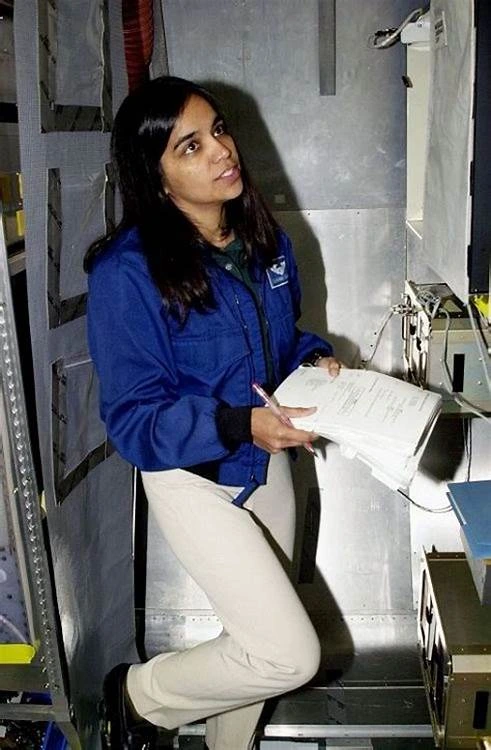
- After a year of training, she became a crew representative to work technical issues for the Astronaut Office EVA/Robotics and Computer Branches where she worked with Robotic Situational Awareness Displays, a tool to help astronauts operate robotic arms and tested software for the space shuttles in the Shuttle Avionics Integration Laboratory.
- Kalpana’s hardwork and expertise earned her recognition within NASA.
- After completing a rigorous training program, she was officially designated as an astronaut in May 1996.
Kalpana Chawla and her First Space Mission: STS-87 (November 19, 1997, to December 5, 1997)
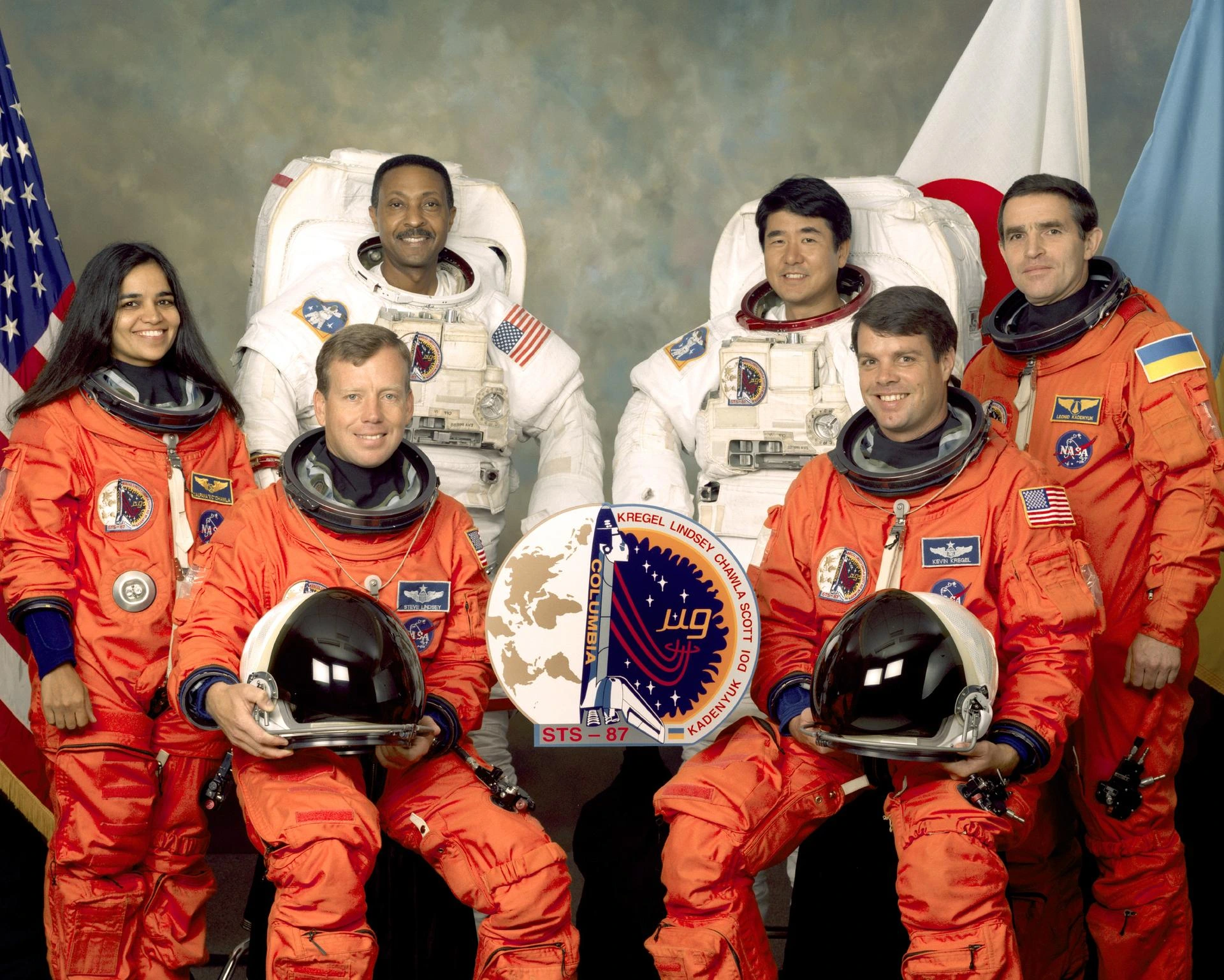
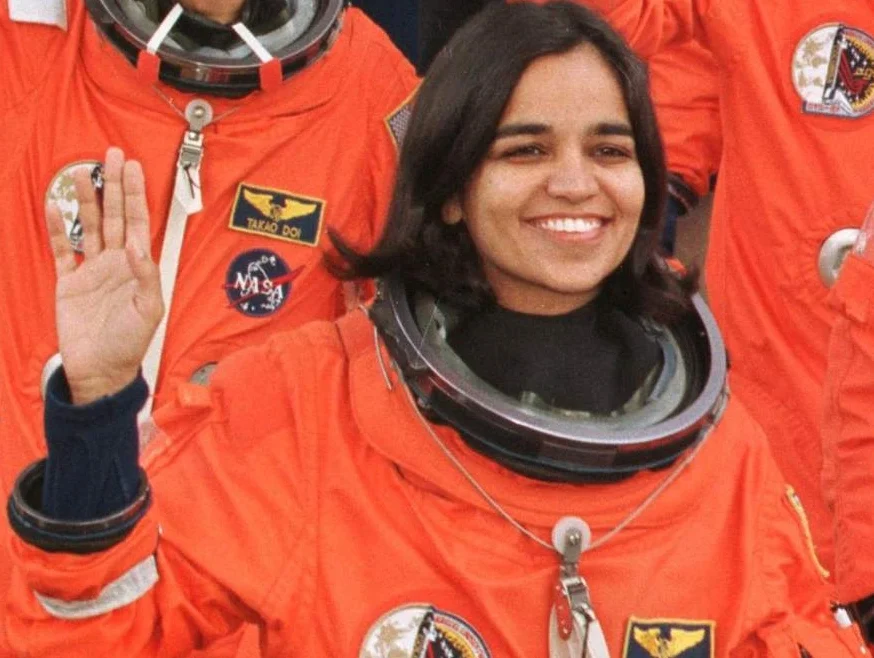
- On November 19, 1997, Kalpana Chawla set the record as the first Indian-born woman and the first South Asian American woman to travel into space on the Space Shuttle Columbia as part of space mission STS-87.
- STS-87 was the fourth U.S Microgravity Payload flight and its main objective was to conduct scientific experiments in microgravity and to deploy and retrieve the SPARTAN-201 satellite, which was designed to study the outer layers of the Sun’s atmosphere, called the corona.
- The shuttle completed two hundred fifty-two orbits of the Earth, travelling 6.5 million miles in 15 days and 16 hours.
- As a mission specialist, Kalpana was responsible for operating the shuttle’s robotic arm to deploy and retrieve the SPARTAN-201 satellite.
- In more than two weeks, she along with her crew conducted numerous experiments based on materials science, fluid mechanics, and combustion science.
- The other projects include studying plant reproduction in microgravity and how materials behave in space.
- However, they faced several challenges. The Spartan satellite malfunctioned due to some software errors and the other two astronauts, Winston Scott and Takao Doi, had to perform a spacewalk to recapture the satellite.
- Despite going through these difficulties, the mission was considered a success, and valuable scientific data was collected.
- While traveling in the weightlessness of space, she spoke: “You are just your intelligence.”
- Indian Prime Minister Inder Kumar Gujral congratulated her and expressed pride on her journey.
- Her achievements on STS-87 earned her widespread recognition and admiration, inspiring millions of people, especially young women, around the world.
- As she returned to Earth after her maiden spaceflight, she commented, “When you look at the stars and the galaxy, you feel that you are not just from any particular piece of land, but from the solar system.”
Kalpana Chawla and her Projects after the Space Mission
- After returning from her first space mission, Kalpana Chawla served technical position in the astronaut office, working on various projects related to spacecraft design and flight operations at NASA.
- She also served as a member of the Astronaut Office EVA (Extravehicular Activity) and Robotics Branch, where she was involved in developing and testing procedures for spacewalks and robotic operations.
- Kalpana’s dedication to her work and her passion for space exploration made her a role model for aspiring astronauts and engineers and even encouraged young students to pursue careers in science, technology, engineering, and mathematics (STEM) fields
- In 2000, Kalpana Chawla was selected by NASA for her second space mission STS-107. She served again as a mission specialist on board the Space Shuttle Columbia.
Kalpana Chawla and her Second Space Mission: STS-107 Ended in Disaster (January 16 to February 1, 2003)
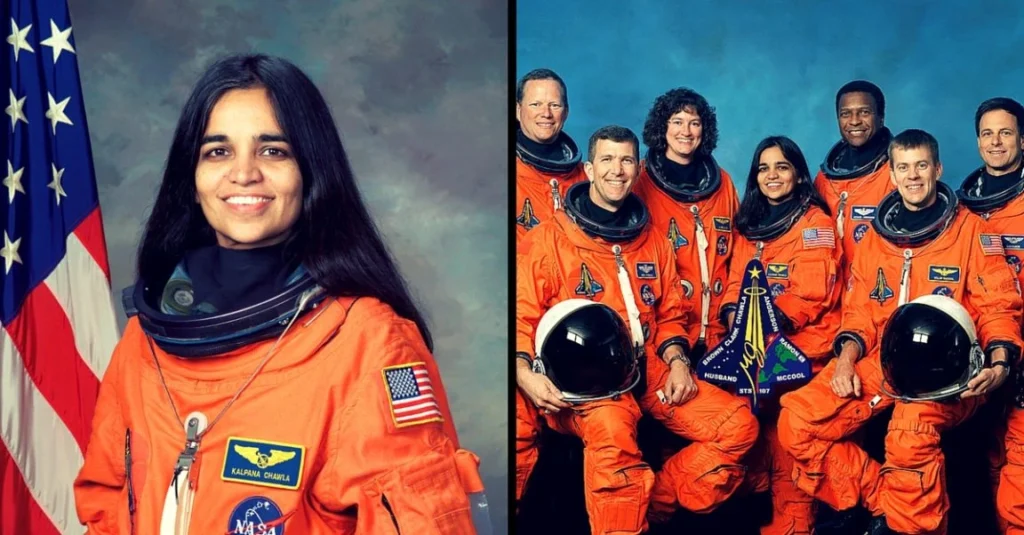
- On 16 January 2003, her second space mission, STS-107 which involved seven astronauts with specific responsibilities, was launched with a view to conduct a wide range of scientific experiments in space.
- During the 16-day flight, the crew successfully performed approximately 80 trials, working 24 hours a day, in two alternating shifts.
- As a mission specialist, Kalpana was responsible for overseeing various experiments related to life science, physical science, and Earth science and how spaceflight affect different physical and biological processes. The crew also studied advanced technology development, and astronaut health and safety.
- She conducted microgravity experiments on biological organisms, the behavior of fluids, combustion and fire suppression in space, and the monitoring of environmental changes on Earth as well as prostrate cancer.
- The flight carried a large, pressurized chamber called the Spacehab research module inside the shuttle’s payload bay. Her task was to manage the Spacehab research module where many of the experiments were performed and to ensure that collected data to be recorded correctly and then conveyed to scientists on the ground.
- The STS-107 crew tested technology to recycle water on the young International Space Station. The other experiments, developed by elementary school students from around the world, were to study the sun and analyze how insects and fish respond to spaceflight.
- On February 1, 2003, the space shuttle Columbia returned to Earth, intending to land at Kennedy Space Center. When the shuttle passed through Earth’s atmosphere for landing, a piece of foam insulation broke off and damaged the thermal protection system, causing hot gas to enter the wing and depressurizing the shuttle, killing Kalpana Chawla with other six crew members- commander Rick D. Husband, pilot William C. McCool, mission specialists David M. Brown, Michael P. Anderson, and Laurel B. Clark, and payload Specialist IIan Ramon, shortly before it was scheduled to conclude its 28th mission, STS-107.
- The shuttle disintegrated over Texas and Louisiana before crashing into the ground.
- The tragedy led a thorough investigation by NASA and independent groups. The Columbia Accident Investigation Board (2003) was formed, and NASA’s Columbia Crew Survival Investigation Report was published in 2008 resulting in significant changes done in NASA’s safety protocols and procedures to prioritize human safety to avoid the catastrophe in future space missions.
- Over the course of her two trips, Chawla spent 30 days, 14 hours, and 54 minutes in space.
Kalpana Chawla and her Awards
- She received the NASA Distinguished Service Medal, NASA Space Flight Medal, and posthumous Congressional Space Medal of Honor.
- Various documentaries have been produced about the crew of Columbia including “Astronaut Diaries: Remembering the Columbia Shuttle Crew” (2005) and “Space Shuttle Columbia: Mission of Hope” (2013).
Kalpana Chawla and her Accomplishments
Kalpana Chawla has been honored in numerous ways. Several institutions, scholarships, and awards have been conferred to her.
Educational Institutions
- The Kalpana Chawla Government Medical College in Karnal, Haryana, India was established to honor her memory and provide quality medical education to students.
- The Kalpana Chawla Memorial Scholarship program was initiated by the Indian Students Association (ISA) at the University of Texas at EI Paso (UTEP) in 2005 for meritorious graduate students.
Scholarships and Awards
- The Kalpana Chawla Scholarship for Young Women in Science and Engineering was established to support female students pursuing careers in science, technology, engineering, and mathematics (STEM) fields.
- The Kalpana Chawla ISU Scholarship fund was founded by alumni of the International Space University (ISU) in 2010 to support Indian women’s participation in international space education programs.
- The Kalpana Chawla Award was instituted by the Government of Karnataka, India in 2004 to recognize young women scientists.
- NASA established the Kalpana Chawla Award to recognize outstanding contributions in the field of aerospace engineering and space exploration.
Memorials and Monuments
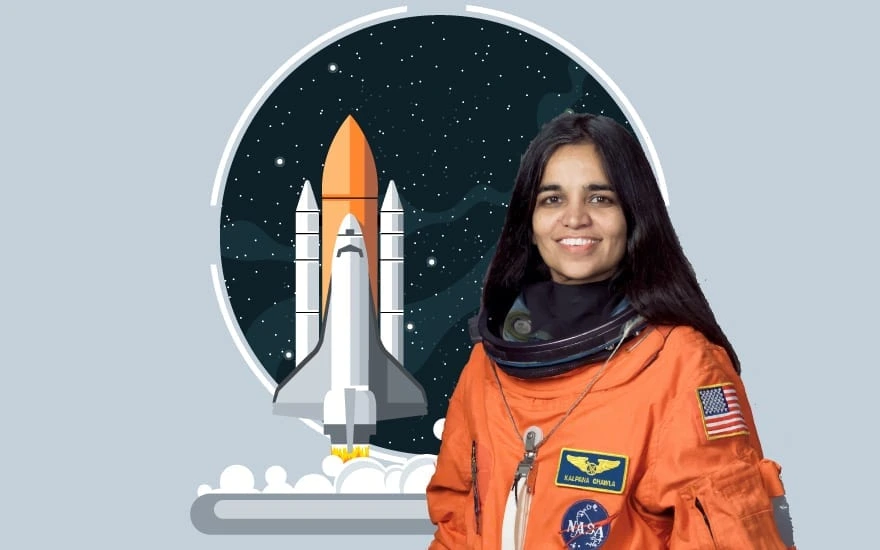
- A statue of Kalpana Chawla was erected at her alma mater, Punjab Engineering College, Punjab, India to commemorate her achievements and inspire future generations of engineers.
- The Kalpana Chawla Memorial Planetarium in Kurukshetra, Haryana, India was established to promote space science education and awareness among students and the general public.
- The University of Texas dedicated a Kalpana Chawla memorial at the Arlington College of Engineering in 2010.
- The Indian Institute of Technology, Kharagpur, India named the Kalpana Chawla Space Technology Cell in her honor
- The NASA Mars Exploration Rover mission has named the Columbia Hills constituted of seven peaks, a chain of hills, after the name of each of the seven astronauts lost in the Columbia shuttle disaster. One of them is Chawla Hill, named after Kalpana Chawla.
Asteroids and Spacecraft
- In 2003, an asteroid discovered by NASA was named “51826 kalpanachawla” in her honor.
- In October 2020, The Cygnus spacecraft, a commercial cargo spacecraft, used by NASA to transport cargo to the International Space Station, has been named “S.S. Kalpana Chawla” to commemorate her contributions to space exploration.
- Northrop Grumman’s Cygnus capsule was named the S.S. Kalpana Chawla.
- On 1 April 2022, a satellite named after Chawla (NuSat 24) or “Kalpana”, COSPAR 2022-033X) was launched into space as part of the Satellogic Aleph-1 constellation.
- On 5 February 2003, the Prime minister of India, Atal Bihari Vajpayee, announced that a meteorological series of satellites, MetSat, was to be renamed “Kalpana 1” “. The first satellite of the series, “MetSat-1”, launched by India on 12 September 2002, was renamed “Kalpana -1”.
Kalpana Chawla and her Personal Life
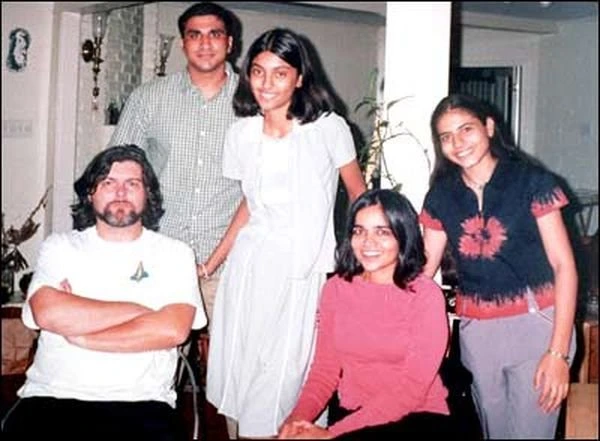
- On 2 December 1983, Chawla got married to Jean-Pierre Harrison at the age of 21. After the Columbia disaster, he wrote a biography called “The Edge of Time” which he published in 2011.
- Beyond her professional achievements, Kalpana Chawla was known for her humility, kindness, and dedication to her work.
- When Kalpana became a NASA astronaut, she felt passionately about ensuring that young girls in India had access to science education. NASA invited Chawla’s secondary school to take part in their Summer Space Experience Program. Each year from 1998, the school sent two girls to the Foundation for International Space Education’s United Space School in Houston and Chawla would invite them into her home for an Indian dinner.
- Kalpana’s father, Banarasi Lal Chawla, also admitted that his daughter’s primary goal was to assist in educating children of low-income families. Even though she was making a good living at NASA, she had no desire for worldly possessions.
- Her colleagues and friends remember her as a warm and approachable person who was always willing to share her knowledge and inspire others.
- Besides her love to impart education, she enjoyed flying, hiking, back-packing in addition to flying tailwheel and aerobatic planes.
- Kalpana was also an avid reader and enjoyed literature, philosophy, and poetry.
She had a deep appreciation for the arts and believed in the importance of a well-rounded education. - Chawla held a Certified Flight Instructor’s license for airplanes, gliders and Commercial Pilot licenses for single and multi-engine airplanes, seaplanes and gliders.
She became the United States citizen in 1991.
Kalpana Chawla and her Net Worth
- Kalpana Chawla’s exact net worth is not publicly documented, as NASA astronauts receive government salaries and her personal finances were never disclosed.
Kalpana Chawla and her Legacy
- Her story serves as a beacon of hope and inspiration, encouraging us to continue exploring the unknown and striving for greatness in all our endeavors.
- Kalpana Chawla would always be remembered as a symbol of courage, innovation, and the relentless pursuit of knowledge.
- When she was a kid, she would gaze at the stars with her siblings. She once said, “Times like those gave me the opportunity to wonder and ask all those very basic questions. That sense of awe for the heavens started there.” This awe would lead her to create legacy and overcame all obstacles that came in her way.
Conclusion: Kalpana Chawla-Encouraging generations to dream
Kalpana Chawla’s story is a reminder that the sky is not the limit; it is just the beginning of what we can achieve when we reach for the stars. Her journey from a small town, Karnal in India to becoming a NASA astronaut and space pioneer serves as an inspiration to aspiring women and girls in science, technology, engineering, and mathematics and countless individuals worldwide to pursue their dreams and create history.
Kalpana Chawla’s contributions to space exploration and her dedication to science and education have left an indelible mark on the field. As a pioneering astronaut, a brilliant scientist, and an inspirational figure who broke barriers, achieved remarkable success and paved the way for future generations.
Key Takeaways About Kalpana Chawla
- Her name “Kalpana” means “imagination” or “creativity” in Sanskrit—a fitting name for a space explorer.
- Kalpana was selected as an astronaut candidate by NASA in 1994 and officially became an astronaut in 1995.
- Kalpana flew two missions in space: STS-87 in 1997 and STS-107 in 2003.
- Her second mission, STS-107, ended in tragedy when Space Shuttle Columbia disintegrated on re-entry on February 1, 2003, killing all seven crew members.
- After her death, NASA called her a “mission specialist and trailblazer” whose spirit continues to live on at the space agency.
- The asteroid 51826 Kalpanachawla was named in her memory by the International Astronomical Union.
- Kalpana’s short yet impactful life proves that it’s not how long you live, but how well you live that defines your legacy.
FAQ on Kalpana Chawla
Web Story on Kalpana Chawla
10 Qualities of Kalpana Chawla as an Astronaut

About Me
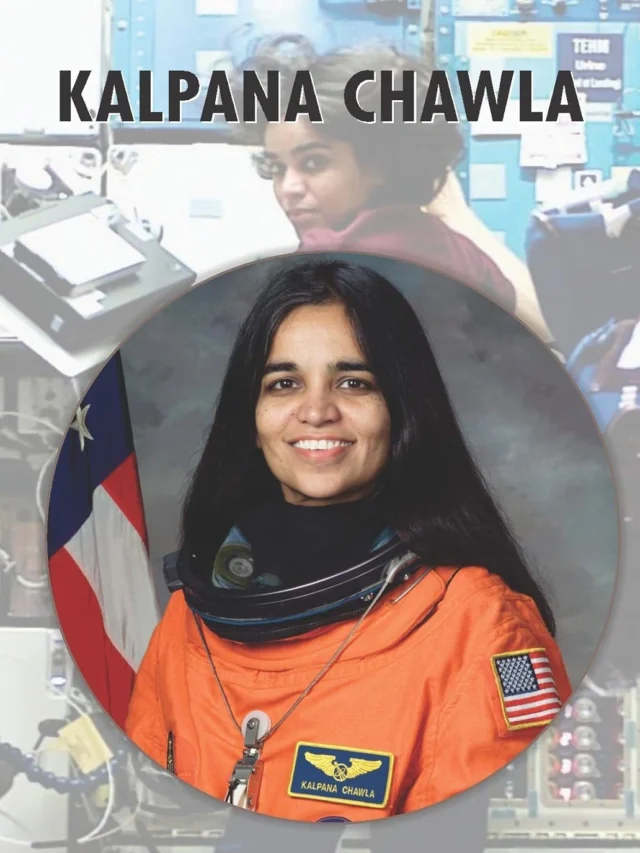
Hello, Bhawana Pant here
I am a biography blogger, dedicated to providing valuable and reliable information about lives and net worth of famous personalities in the world. My insightful and engaging content stands out for my unique approach to offer facts as well as inspire others to achieve success in their lives.